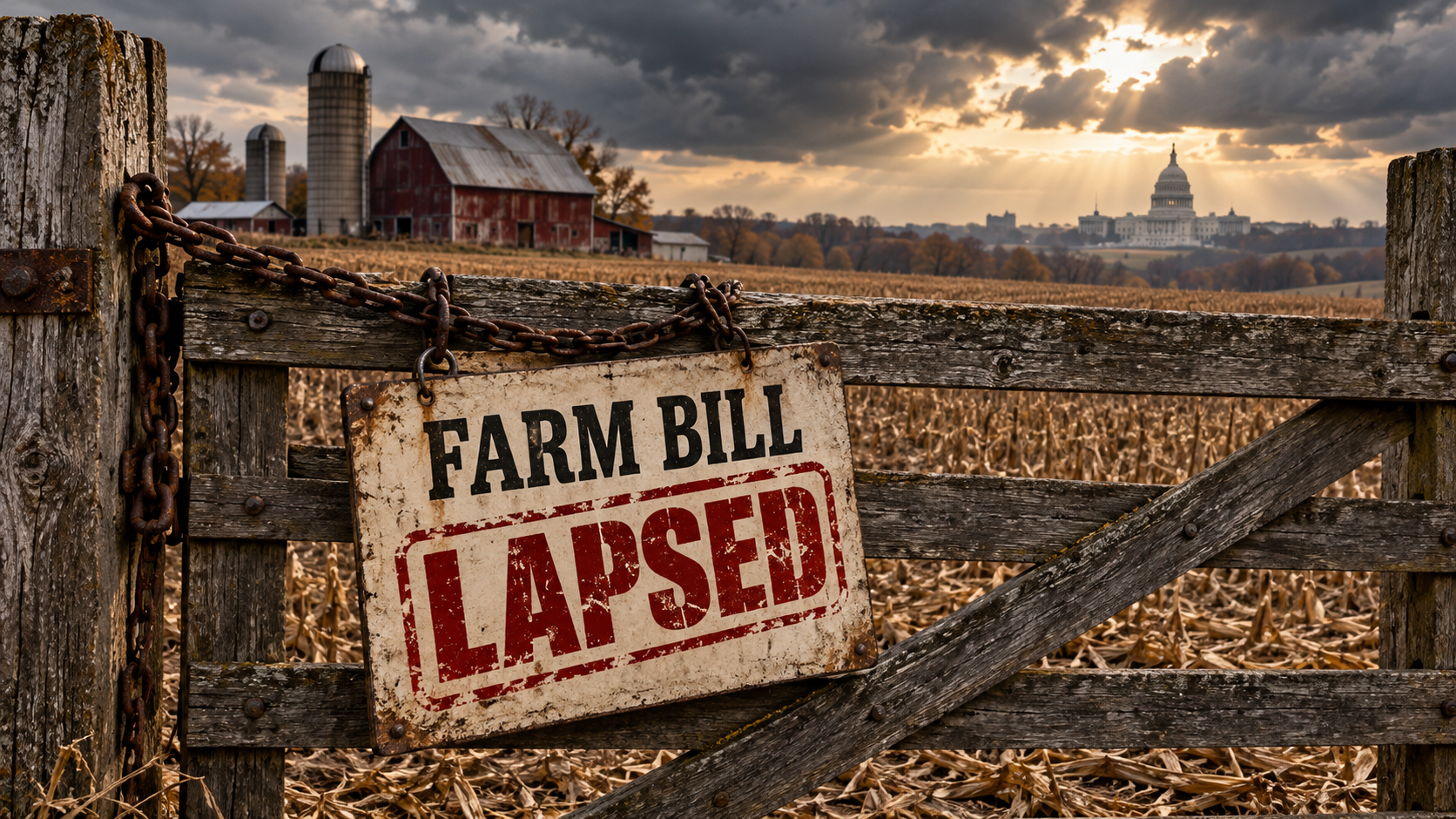
The latest expiration of the 2018 farm bill has halted funding for some agricultural programs and stopped new Conservation Reserve Program contracts, while several major farm safety net programs remain protected under separate legislation.
The farm bill expired Sept. 30 for the fourth consecutive year. National Farmers Union says the lapse creates uncertainty for family farmers, ranchers and rural communities, even though its effects vary by program. Some consequences began Oct. 1. Others could develop in the coming months if Congress does not act.
For producers, the distinction matters. An expired farm bill does not shut down every federal agricultural program at once. Separate funding laws, existing contracts and crop year schedules determine when individual programs are affected.
New CRP contracts on hold
According to National Farmers Union, three programs lost funding when the farm bill expired: Biobased Markets Programs, the Biorefinery Assistance Program and the Rural Economic Development Program.
The expiration also affects the Conservation Reserve Program, which pays participating landowners to remove environmentally sensitive acreage from agricultural production and maintain conservation cover.
Existing CRP contracts will continue to be honored. However, USDA cannot enter into new CRP contracts without renewed program authority.
That leaves a different situation for landowners already enrolled and those seeking a new contract. Current agreements remain in place, while new contracts depend on congressional action.
More programs face uncertainty
Other programs face longer-term disruptions as their authority or available funding runs out.
National Farmers Union identifies several programs at risk without reauthorization, including the Local Agriculture Market Program, Specialty Crop Block Grants, Farming Opportunities Training and Outreach, the Organic Agriculture Research and Extension Initiative, the Senior Farmers’ Market Nutrition Program and Food for Progress.
Agricultural export development efforts also face uncertainty. Those include the Market Access Program, Foreign Market Development, the Emerging Markets Program and Technical Assistance for Specialty Crops.
The expiration does not necessarily mean every activity under those programs stops immediately. National Farmers Union says USDA will eventually be unable to carry out affected programs without renewed authority and funding.
Another group of programs depends on two separate congressional decisions. The farm bill authorizes their operation, but annual appropriations legislation supplies their money. Continuing those programs can require lawmakers to address both authorization and funding.
Older farm laws could create another deadline
A prolonged lapse also raises the possibility of returning to commodity support policies written into federal law in 1938 and 1949.
Those provisions are commonly called “permanent law.” Congress has repeatedly suspended them through subsequent farm bills, allowing newer policies to operate in their place.
The timing follows commodity crop years rather than the federal fiscal year. That means the Sept. 30 expiration does not immediately trigger all the consequences associated with those older policies.
National Farmers Union says dairy could be the first commodity affected in early 2027, with certain crops following later. The potential return of outdated dairy support requirements is often called the “dairy cliff.”
Implementing those policies could increase federal costs and disrupt agricultural markets. National Farmers Union expects Congress to prevent that outcome, although that expectation does not resolve the legislative deadline.
Major safety net programs remain in place
Several programs important to Missouri and Midwest producers have authority extending beyond the expired farm bill.
The 2025 budget reconciliation law, commonly called the One Big Beautiful Bill Act, extended major agricultural provisions through 2031. Those protections include Agriculture Risk Coverage, Price Loss Coverage and Dairy Margin Coverage. Crop insurance also remains in place.
Major conservation programs for working agricultural land received support through fiscal year 2031. They include the Environmental Quality Incentives Program, Conservation Stewardship Program, Regional Conservation Partnership Program and Agricultural Conservation Easement Program.
Those programs operate separately from CRP, so their continued authority does not allow USDA to resume writing new CRP contracts.
The reconciliation law also addressed many smaller programs that previously faced funding cliffs whenever a farm bill expired.
National Farmers Union says 39 programs faced that problem when the 2014 farm bill briefly expired. Changes in the 2018 legislation reduced the number to 19 when that bill first expired. Following the 2025 reconciliation law, three remain in that category.
Why this expiration is different
The 2025 law narrowed the immediate damage from another farm bill lapse, but it did not replace the full farm bill process.
Budget reconciliation allows Congress to move qualifying tax and spending legislation through the Senate without the usual 60 votes needed to overcome a filibuster. However, the Senate’s Byrd Rule generally restricts provisions that do not sufficiently relate to federal spending or revenue.
That limits the broader agricultural policy changes lawmakers can make through reconciliation.
National Farmers Union also notes that the 2025 farm bill expiration coincided with a partial government shutdown. The shutdown created additional disruptions beyond those caused by expired farm bill authority. The organization says that combination is not part of this year’s lapse.
Farmers Union presses for broader changes
National Farmers Union is urging Congress to pass a new farm bill that addresses both program continuity and the economic pressures facing family operations.
The organization wants a farm safety net that reflects current production costs and market conditions. It also supports stronger competition protections through enforcement of the Packers and Stockyards Act and reinstatement of mandatory country-of-origin labeling for beef.
Its market development priorities include year-round nationwide sales of E15 gasoline and additional investment in local and regional food markets.
Those proposals represent National Farmers Union’s policy agenda. The immediate issue for producers is which existing programs can continue and which require Congress to restore their authority or funding.