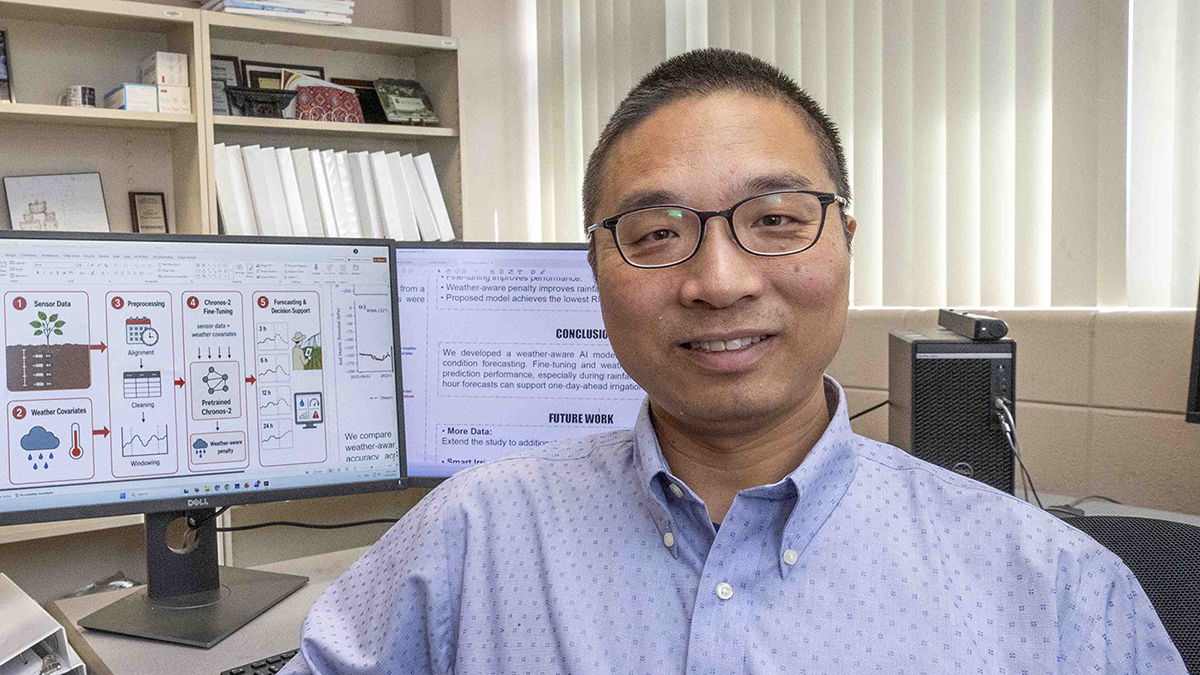
Chao Lu leads Southern Illinois University’s work on a soybean drought-monitoring project with the University of Missouri. Photo by Russell Bailey, courtesy of Southern Illinois University Carbondale.
University of Missouri researchers are joining a $300,000 project to determine whether drones and artificial intelligence can help farmers monitor drought stress in soybean fields.
The partnership with Southern Illinois University Carbondale brings agricultural expertise together with engineering and computer analysis. Funding comes from USDA’s National Institute of Food and Agriculture, and the research continues through June 30, 2027.
Finding stress across a field
The researchers are developing computer models that analyze drone imagery for different levels of soybean wilting. Their goal is to complement the observations farmers make while scouting.
Water stress can affect leaf color, shape and posture. However, checking those changes consistently across a large operation takes time, and conditions can differ within a single field.
Chao Lu, who leads SIU’s part of the project, says the team wants agricultural technology to become more practical and accessible for farmers.
Field conditions test the technology
The work remains in development. Researchers must determine whether the models perform reliably when conditions differ from those used to train them.
Lighting, soils, weather and crop growth can change how plants appear in aerial images. Building dependable models also requires field observations that agricultural specialists can use to check the computer’s assessments.
Two SIU graduate students are working on model development and data analysis. Mizzou researchers contribute knowledge of soybean production and the challenges growers face in the field.
More information could improve monitoring
The team plans to evaluate its models under a wider range of growing conditions. Researchers are also interested in combining drone images with soil measurements and weather information.
Affordability is another consideration as the universities explore how the research could eventually serve producers. The grant also supports outreach to agricultural audiences about the technology and the project’s findings.
Leave a Reply